Artificial Intelligence has evolved far beyond simple chatbots. In 2026, businesses are increasingly deploying Enterprise AI Agents to automate repetitive tasks, optimize workflows, improve customer experiences, and reduce operational costs.
Unlike traditional automation tools that rely on predefined rules, Enterprise AI Agents can understand context, analyze business data, make intelligent decisions, and even collaborate with employees. Organizations across finance, healthcare, manufacturing, retail, logistics, legal services, and technology are adopting AI-powered workflow automation to improve productivity and achieve faster business growth.
What Are Enterprise AI Agents?
Enterprise AI Agents are intelligent software systems powered by advanced AI models, machine learning, natural language processing (NLP), and automation technologies. These agents can perform tasks independently, interact with enterprise applications, analyze large datasets, and make decisions based on business rules.
Unlike traditional robotic process automation (RPA), AI Agents continuously learn from interactions and improve their performance over time.
Key capabilities include:
- Natural language understanding
- Autonomous task execution
- Workflow optimization
- Predictive decision-making
- Real-time data analysis
- Multi-system integration
- Context-aware conversations
- Continuous learning
Why Businesses Are Investing in AI Workflow Automation
Organizations face increasing operational complexity. Manual processes consume valuable employee time and often lead to delays and errors. Enterprise AI Agents help businesses by reducing repetitive manual work, increasing operational efficiency, improving customer satisfaction, accelerating decision-making, lowering operational costs, enhancing compliance, scaling operations without proportional hiring, and delivering consistent service quality.
Key Features of Enterprise AI Agents
Intelligent Decision Making
AI Agents evaluate business rules, historical data, and live information to recommend or execute actions automatically.
Multi-System Integration
Enterprise AI integrates seamlessly with CRM systems, ERP platforms, HR software, accounting tools, customer support platforms, marketing automation systems, cloud infrastructure, and internal databases.
Natural Language Processing
Employees can communicate using everyday language instead of technical commands. For example: “Generate last month’s sales report and email it to management.” The AI Agent understands the request and completes the task automatically.
Predictive Analytics
Enterprise AI Agents forecast sales trends, customer churn, inventory demand, equipment failures, financial risks, and workforce planning.
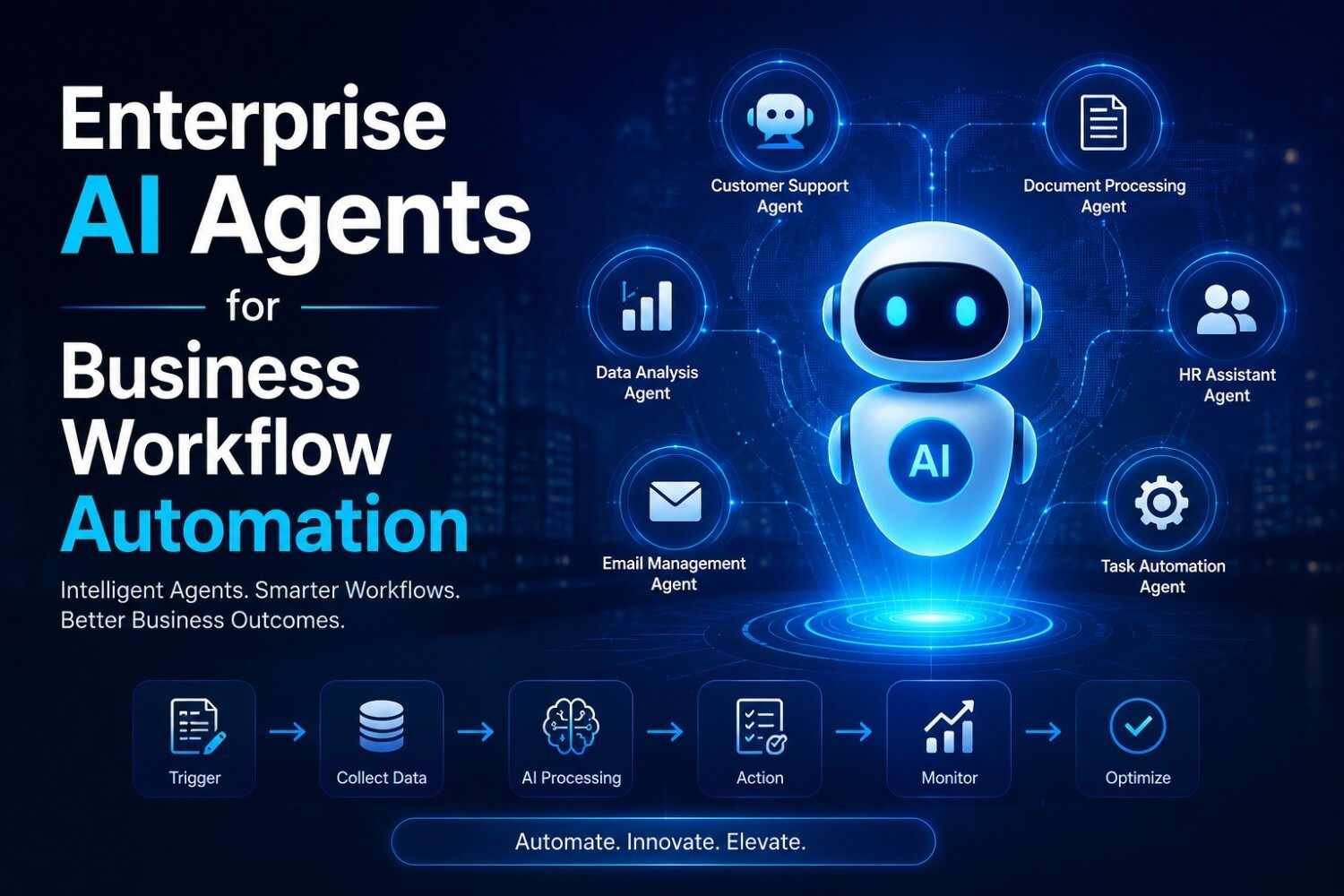
How Enterprise AI Agents Automate Business Workflows
- Data Collection – The AI gathers information from enterprise applications.
- Data Analysis – Machine learning models identify patterns and anomalies.
- Decision Making – The AI selects the best action based on business objectives.
- Task Automation – Tasks are executed automatically without human intervention.
- Monitoring – Performance metrics are continuously monitored and optimized.
Top Business Use Cases
Customer Support
AI Agents can answer FAQs, resolve tickets, escalate complex issues, generate support summaries, and provide multilingual assistance.
Human Resources
Automate resume screening, employee onboarding, payroll queries, leave approvals, and performance tracking.
Finance
Improve invoice processing, expense management, fraud detection, budget forecasting, and financial reporting.
Sales & Marketing
Support lead qualification, CRM updates, proposal generation, customer follow-ups, revenue forecasting, email campaigns, content generation, and campaign optimization.
Benefits of Enterprise AI Workflow Automation
- Increased Productivity – Employees spend less time on repetitive administrative work.
- Cost Savings – Automation reduces labor-intensive operations and minimizes costly errors.
- Better Accuracy – AI processes large volumes of information consistently and accurately.
- Faster Decision Making – Real-time analytics enable quick responses to changing conditions.
- Enhanced Customer Experience – Customers receive instant responses and personalized recommendations.
Enterprise AI vs Traditional Automation
| Feature | Traditional Automation | Enterprise AI Agents |
|---|---|---|
| Rule-Based | Yes | No |
| Learning Capability | No | Yes |
| Decision Making | Limited | Advanced |
| Language Understanding | No | Yes |
| Adaptability | Low | High |
| Data Analysis | Basic | Advanced |
| Scalability | Moderate | Excellent |
Future Trends in Enterprise AI
- Collaborate as multi-agent systems
- Execute end-to-end business processes autonomously
- Provide hyper-personalized employee assistance
- Enable real-time business intelligence
- Integrate with IoT and edge computing
- Support autonomous enterprise operations
- Enhance cybersecurity through AI-driven threat detection
Frequently Asked Questions (FAQs)
What are Enterprise AI Agents?
Enterprise AI Agents are intelligent software systems that automate business processes, analyze data, and make decisions across enterprise applications.
How do AI Agents improve workflow automation?
They reduce manual tasks, increase efficiency, improve accuracy, and accelerate decision-making through intelligent automation.
Are Enterprise AI Agents secure?
Most enterprise-grade AI platforms provide encryption, access controls, audit logs, and compliance features such as GDPR and SOC 2.
Conclusion
Enterprise AI Agents are reshaping how modern organizations operate by combining automation, intelligence, and real-time decision-making. From customer support and finance to HR, sales, and supply chain management, AI-driven workflow automation helps businesses increase efficiency, reduce costs, and deliver better customer experiences.
As AI technology continues to evolve, organizations that adopt Enterprise AI Agents strategically will be better positioned to improve productivity, scale operations, and remain competitive in an increasingly digital marketplace.